When you read executive-level RCM job descriptions today, you’d think the future looks a lot like the past. The words “AI” and “transformation” show up everywhere, but the descriptions themselves are built for a world that no longer exists. They optimize for operators of incremental systems, not architects of adaptive ones.
After a year of watching the market — both as a candidate and as someone building a consulting practice — the disconnect is obvious:
We’re still hiring leaders for yesterday’s model, while telling ourselves we’re ready for tomorrow’s work.
And if we don’t fix that, we’re going to automate the wrong things, reinforce old constraints, and hand most of the value to vendors.
The job descriptions give it away
Over the last 12 months, I’ve reviewed postings across hospitals, PE-backed platforms, and large RCM vendors. What they all have in common is the same checklist approach:
“Data driven.”
“Improve KPIs.”
“Standardize workflows.”
“Implement automation.”
“Manage vendors.”
“Drive productivity.”
None of this is wrong. It’s just not transformation.
This is what traditional job descriptions produce: a leader who inherits a system, makes incremental improvements using yesterday’s methodologies and maintains it. Someone who optimizes for efficiency, conformance, and predictable outputs.
But transformation is not a maintenance function. It’s not “automate what we have.” It’s not “run the same playbook/best practices faster with fewer people.”
Transformation is a redesign problem.
Transformation is a capability problem.
Transformation is a learning-rate problem.
And none of that shows up in most executive descriptions today.
A recent interview made the flaw obvious
In one interview for a senior RCM leadership role, I got the classic question:
“What should AR days be for this vertical?”
I gave the right answer. But the question itself was wrong.
The real question — the one aligned to the world we’re moving into — is:
“Are AR days an important metric in the future? If so, what could AR days be if we redesigned the system around AI, automation, and rapid learning loops?”
One question optimizes for the past.
The others open the door to what’s possible.
Most companies are still asking the first one.
We’ve seen this pattern before
Twenty years ago, during early offshoring, organizations tried to “lift and shift” without understanding their own processes. They used a train-the-trainer model. They handed partial documentation to BPO partners and expected magic.
What they got was predictable:
Lost nuance
Repeated errors
Slow learning cycles
Frustrated teams
Minimal real capability
It wasn’t until we flipped the model — training everyone, not just trainers, and listening bottom-up — that capability began to compound.
AI has the same shape, it's a new paradigm using an old playbook.
Same predictable failure pattern.
The old model vs the model we need
Here’s the truth: You can’t transform a system by hiring people who were trained to maintain the old one.
Most executive RCM roles today are designed for:
The Old Model
Efficiency and throughput
Standardization
Managing people doing linear workflows
Vendor oversight
Tight control and predictable output
KPI management: AR days, DNFB, NCR, denials
It's neat, it is something entirely different:
The New Model
First-principles thinking
Systems architecture
Adaptive, domain-driven process design
AI fluency and governance
Building data and decision literacy throughout the organization
Defining new KPIs: learning velocity, decision turnaround time, adaptability
Designing organizations that get smarter, not just faster
The goal isn’t to automate yesterday, it's to architect tomorrow.
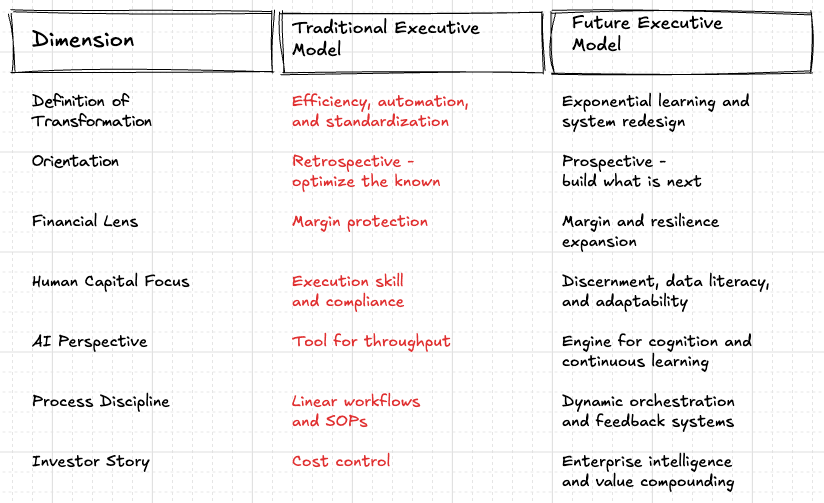
What the Old Job Description Actually Sounds Like
This is the condensed pattern across nearly every posting I’ve reviewed.
Old Job Description Language
Lead all revenue cycle operations
Ensure KPI performance (AR days, DNFB, net collections)
Standardize processes across teams
Drive productivity and compliance
Manage vendor performance
Oversee automation initiatives
Improve reporting and analytics
Partner with IT on system enhancements
Recruit and develop staff
This is the job of someone who inherits a fixed system and drives consistency.
What a Future-Ready Job Description Should Sound Like
Designed backwards from the system you’ll need in an AI-enabled revenue cycle.
Future-Focused Job Description Language
Architect adaptable, AI-enabled workflows across the entire revenue cycle
Build and govern internal AI + automation capabilities
Redesign core processes from first principles, not legacy constraints
Establish new KPIs: learning velocity, adaptability, decision turnaround time
Lead development of data literacy and discernment across teams
Implement real-time decision support and orchestration
Build cross-functional learning loops between finance, operations, and tech
Identify and eliminate structural constraints slowing revenue performance
Position the org to capture value before vendors do
Side by side, the gap becomes undeniable.
Why this matters for boards, CFOs, and CEOs
If you hire to the old model:
You freeze your operations in the past.
Vendors will own the learning loops — and the value creation.
You miss the speed advantage. AI is fast; what took 20 years with BPO will play out in 5–7 years.
You end up measuring success with KPIs that don’t predict future performance.
Revenue cycle has always been an asymmetric cat-and-mouse game between clinicians and payers.
Payers have scale. Providers are forced to win with speed, adaptability, and learning. The only real competitive advantage is learning faster than the other side. Learn faster and win, it's that simple.
So what does transformation require?
Three things:
A redesign of organizational capability from first principles.
Who wields the tools? How does learning spread? How does judgment improve?Internal AI + automation centers of excellence.
Not vendor-led. Not outsourced.
Providers must own their data and cognitive capability going forward – not rent it from the vendor ecosystem.New KPIs that measure adaptability.
The old metrics (including AR days) still matter, but they no longer define leadership. The ability to redesign, adapt, and learn faster than payers do – that’s the new performance frontier.
Superior discernment and decision turnaround time matter more than retrospective metrics.
Transformation is not a destination but rather a system that learns continuously and becomes more resilient over time.
Hiring needs to work backwards from the future
Instead of writing executive RCM roles that describe what the job used to be, start with the system you need to build:
Do we want a system that learns faster than our competitors?
Do we want internal capability instead of dependency?
Do we want data and decisions that compound value instead of maintaining yield?
If the answer to any of those is yes, the leadership profile changes immediately.
You stop asking:
“Who has run a system like ours before?”
And you start asking:
“Who can build the system we’re going to need?”
That’s the pivot revenue cycle leadership is missing today.
Where do we go from here?
Here’s a start:
Rewrite senior RCM roles as architect roles, not operator roles.
Design the job backwards from the future you want, not the history you have.
Embed AI, design thinking, orchestration, and learning systems into the expectations.
Measure leaders by adaptability and capability creation, not just KPI maintenance.
Stop outsourcing your cognitive ability to vendors.
Build internal capacity that compounds over time.
If we get this right, we’ll stop automating yesterday’s problems and start building tomorrow’s possibilities.
If we don’t, the future will happen anyway — just without us leading it.